Overview
Welcome to the documentation for the freely-walking optomotor experiments conducted in the Reiser Lab. This section covers everything you need to know to run, process, and analyse experiments using the G3 LED arena.
Background
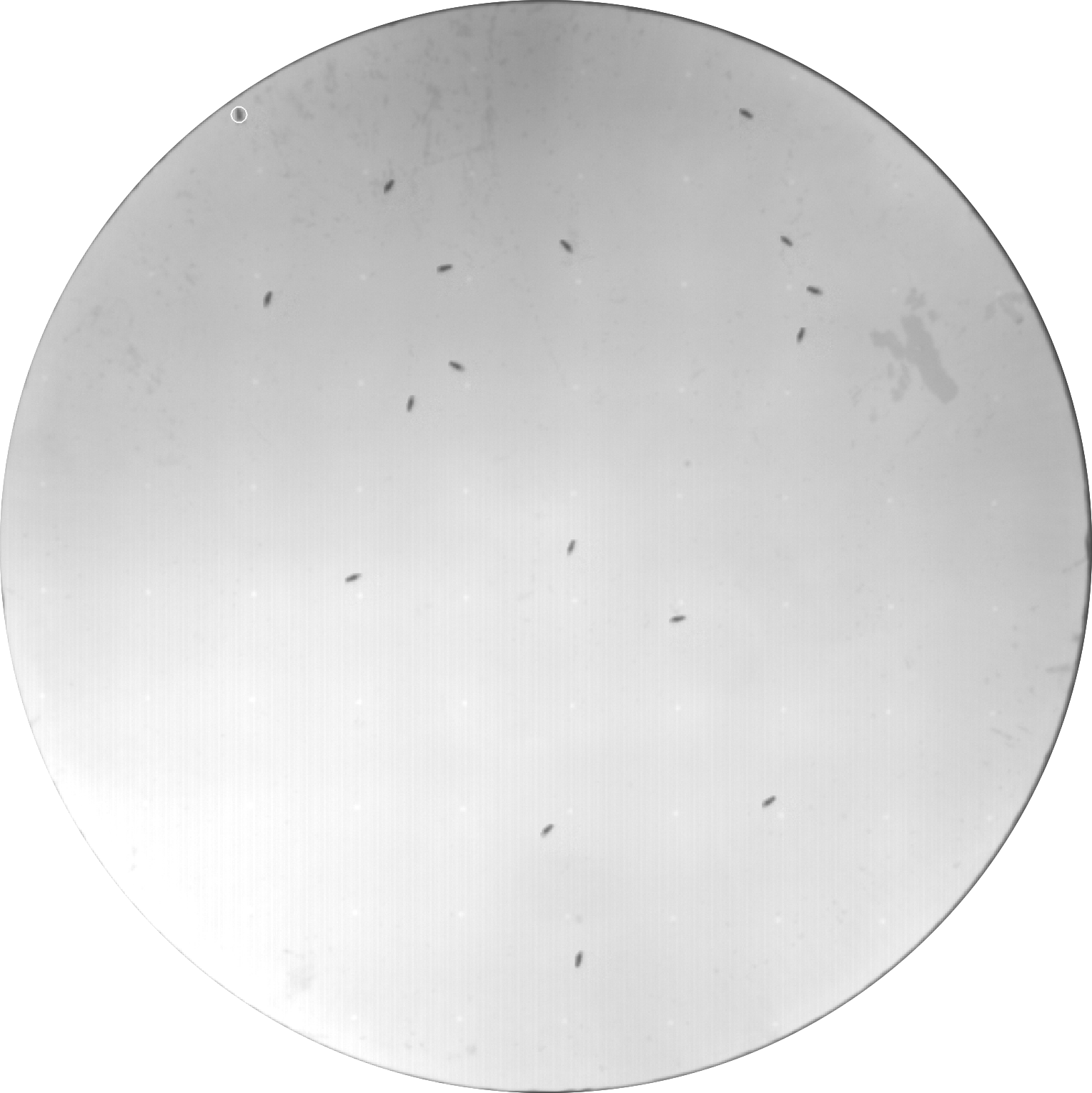
The Freely Walking Course Control Mechanisms screen was conducted in 2025 using the G3 LED arena in the Reiser Lab at HHMI’s Janelia Research Campus.
The screen measures optomotor responses, motion-induced centring behaviour, and general locomotion metrics in freely-walking Drosophila. Flies are presented with moving visual stimuli (gratings, bars, flicker, curtains, reverse-phi) while their trajectories are tracked at 30 fps.
The experiment protocol was designed by Laura Burnett and experiments were conducted by Laura Burnett and Aparna Dev from PTR. All fly husbandry was carried out by Edward Rogers.
Section guide
| Page | Description |
|---|---|
| Quickstart | Step-by-step instructions for running, creating, and analysing experiments — start here if you are new |
| Rig Specs | Hardware and software requirements for the G3 LED arena setup |
| Pipeline | Experiment workflow, the automated processing pipeline, and the pipeline status page |
| Data Organisation | How raw, tracked, and processed data is structured and where it is stored |
| Protocols | |
| Protocols Overview | Full list of experimental protocols with timing, conditions, and lineage |
| Experiment Logging | How experiment metadata is logged to Google Sheets |
| Patterns | |
| Patterns Overview | Catalogue of all LED pattern files with previews and parameters |
| Analysis | |
| Analysis | The three-level data processing and analysis pipeline |
| Analysing a New Protocol | Guide to analysing data from protocols other than the main screen protocol |
| Visualisation | Generating per-condition stimulus videos with fly trajectories |
| Recording Observations | Manual behavioural scoring using the review GUI |
| Dashboard | Interactive Dash web dashboard for exploring processed data |
| Reference | |
| Configuration & Paths | Three-computer setup, path configuration, and automation scripts |
| Troubleshooting | Common issues and solutions organised by category |
Code availability
The code for generating and running these protocols, processing and plotting the data, generating the documentation and the interactive dashboard is publicly available at github.com/leburnett/freely-walking-optomotor.
Data availability
Experiment data is saved directly on the acquisition computer after running an experiment.
This data is then copied to the prfs group drive and copied locally onto the processing computer to be processed.
The results of the processing and analysis are saved on the analysis computer and backed up to the prfs group drive.
See Configuration & Paths for details on the three-computer setup and path configuration.
See the Data Organisation page for details on the exact paths to where the data is stored and how it is structured.
Key Resources
| Resource | Type | Description |
|---|---|---|
| Dashboard | Visualiser | Interactive web dashboard for exploring processed data. Python app |
| Trajectory viewer | Visualiser | Interactive html page for visualising trajectories |
Pipeline-status.html page |
Log | Status page for the automated processing pipeline (see Pipeline) |
| Google Sheets experiment log | Log | Automatic log filled in after the completetion of successful experiments (see Experiment Logging) |
| Training Guide PDF | Documentation | Step-by-step guide for training new experimenters on the G3 LED arena setup |
| Reiser Lab LED Panel documentation | Documentation | Detailed documentation on the specifications of the G3 arena and how to design and run protocols |